



OGame Intergalactic Research Network (IRN): Costs, Lab Math and When to Research It
How the Intergalactic Research Network links your Research Labs: requirements, the full cost table, the research time formula, how the game picks labs, worked examples and when the IRN is worth it.

Short answer: the Intergalactic Research Network (IRN) links Research Labs on different planets so their levels are added together for research time. Each IRN level connects one more lab to the lab where you start the research. It requires Research Lab 10, Computer Technology 8 and Hyperspace Technology 8, level 1 costs 240,000 metal, 400,000 crystal and 160,000 deuterium, and every level doubles the cost. Labs below the lab level a technology needs are left out, so the network only works as well as your colony labs.
Research becomes the slowest part of OGame surprisingly early. Mines keep up with a few upgrades, but a single lab cannot keep up with technologies that cost millions of resources. The IRN is the standard answer, and it is also one of the easiest technologies to waste resources on if you do not understand how it picks labs.
In this guide
- What the IRN does
- The research time formula
- Requirements and cost per level
- How the game chooses which labs join
- Worked examples
- When to research it, and how far to go
- Common IRN mistakes
What the IRN does
- You can still only run one research at a time across your whole account. The IRN does not add research slots.
- What it changes is the effective lab level: the lab where you start the research, plus one extra lab per IRN level, are added together.
- Joining is automatic. The game adds your highest eligible labs first; you do not pick them.
The research time formula
According to the OGame Wiki, the base research time is:
Time (hours) = (Metal + Crystal) / (1000 × universe speed × (1 + lab level))
With the IRN, "lab level" becomes the combined level of the connected labs. Because the lab level sits in the divisor, adding a second lab of similar level almost halves the time, which is why the first IRN level is so strong. Some universes apply an additional research speed divisor on top; the public server data lists it as researchDurationDivisor. Class and other bonuses, such as the Discoverer's shorter research time, are applied on top as well.
Requirements and cost per level
Requirements: Research Lab level 10, Computer Technology level 8, Hyperspace Technology level 8.
| IRN level | Metal | Crystal | Deuterium | Labs working together |
|---|---|---|---|---|
| 1 | 240,000 | 400,000 | 160,000 | 2 |
| 2 | 480,000 | 800,000 | 320,000 | 3 |
| 3 | 960,000 | 1,600,000 | 640,000 | 4 |
| 4 | 1,920,000 | 3,200,000 | 1,280,000 | 5 |
| 5 | 3,840,000 | 6,400,000 | 2,560,000 | 6 |
| 6 | 7,680,000 | 12,800,000 | 5,120,000 | 7 |
| 7 | 15,360,000 | 25,600,000 | 10,240,000 | 8 |
| 8 | 30,720,000 | 51,200,000 | 20,480,000 | 9 |
Using the formula above, IRN level 1 itself takes about 58 hours at universe speed 1 with a level 10 lab: (240,000 + 400,000) / (1000 × 11).
How the game chooses which labs join
- The lab where you start the research always takes part. That is the planet holding the resources you pay with.
- Labs below the minimum lab level for that technology are excluded. Shielding Technology needs a level 6 lab, Hyperspace Drive level 7, Graviton Technology level 12. A level 4 colony lab contributes nothing to those.
- The remaining labs join highest first, up to IRN level + 1 labs in total.
Two consequences matter in practice. First, you should usually start research on one of your highest labs, because a low starting lab takes a slot in the network. Second, there is no point researching the IRN beyond "number of planets minus 1", because you cannot have more labs than planets. The number of planets you can own depends on Astrophysics.
Worked examples
These follow the OGame Wiki's examples, with labs at levels 10, 8, 6 and 4.
| IRN | Research | Required lab | Start on | Effective lab level |
|---|---|---|---|---|
| 2 | Shielding Technology | 6 | Lab 10, 8 or 6 | 10 + 8 + 6 = 24 |
| 2 | Hyperspace Drive | 7 | Lab 10 or 8 | 10 + 8 = 18 (labs 6 and 4 excluded) |
| 1 | Shielding Technology | 6 | Lab 10 or 8 | 10 + 8 = 18 |
| 1 | Shielding Technology | 6 | Lab 6 | 6 + 10 = 16 (starting lab always included) |
What it does to research time
Take a technology level costing 1,600,000 metal and crystal combined, at universe speed 1:
| Setup | Effective lab level | Research time |
|---|---|---|
| One lab at level 12 | 12 | about 123 hours |
| IRN 1: labs 12 + 10 | 22 | about 70 hours |
| IRN 2: labs 12 + 10 + 10 | 32 | about 48 hours |
| IRN 3: labs 12 + 10 + 10 + 10 | 42 | about 37 hours |
The first level cuts the time by more than 40%; later levels still help, but each adds a smaller share while its cost doubles.
When to research it, and how far to go
- Research level 1 as soon as you meet the requirements and have at least one colony lab at level 8 to 10. The payoff is immediate on every expensive research.
- Raise colony labs before raising the IRN. An IRN level that connects a weak lab adds almost nothing, and lab upgrades are far cheaper than high IRN levels.
- Aim for colony labs at the level your target technologies require: at least 7 for hyperspace research, 12 if you are working towards Graviton Technology, which also needs 300,000 energy on the researching planet.
- Stop at planets minus one. With 9 planets, IRN 8 already connects every lab.
- Discoverers benefit twice: shorter base research times and bigger colonies with more fields for labs. See our OGame classes guide.
Common IRN mistakes
| Mistake | Why it hurts |
|---|---|
| Starting research on a low colony | The starting lab always joins and pushes out a stronger one |
| Researching IRN 5 with level 3 colony labs | Those labs are excluded from most technologies anyway |
| Expecting parallel research | The IRN speeds up one research; it never adds a second queue |
| Researching past planets minus one | There are no more labs to connect |
| Forgetting cancellation refunds | Cancelling research returns its resources, which some players use to hide resources from raids |
Research at x500
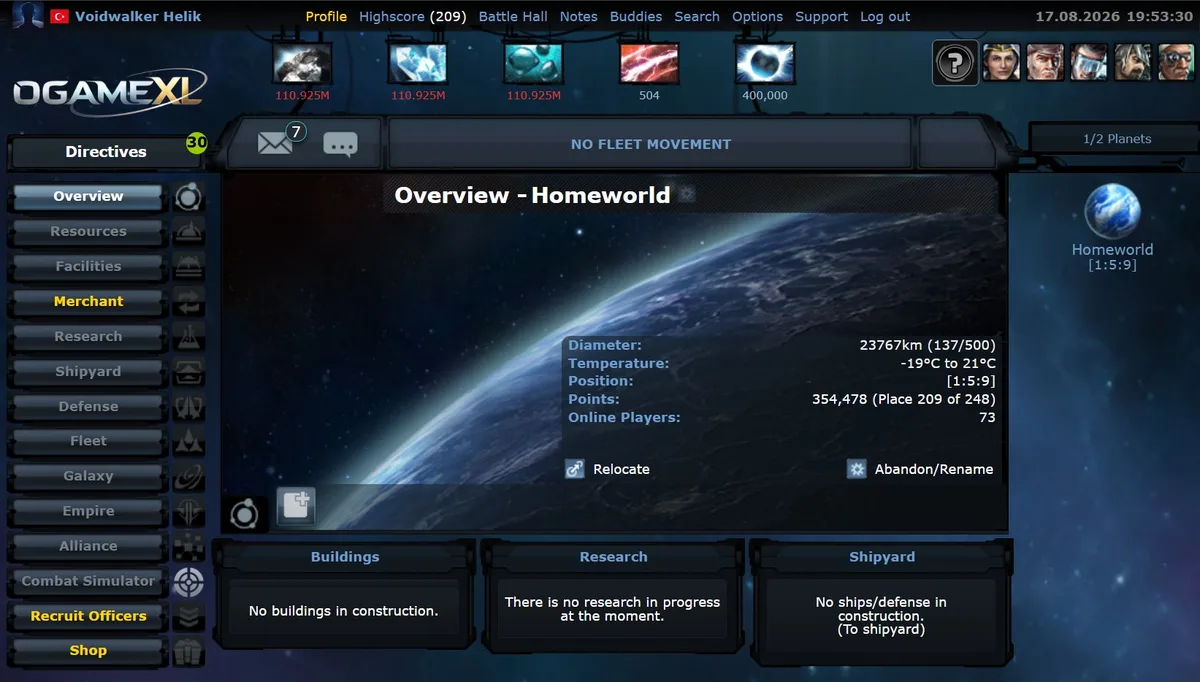
On OGameXL's Centaurus universe, research runs at x500 against a x1000 economy, so research stays the real bottleneck and lab networks still matter, just in hours instead of weeks. It recreates classic OGame before Lifeforms, with one research tree and no Lifeform technologies competing for your attention. Our OGame x1000 guide shows the math.
Sources
- OGame Wiki: Intergalactic Research Network (requirements, cost table, lab selection rules and examples), Research (research time formula), Research Lab.
- OGame public API: serverData.xml (researchDurationDivisor).
Related Guides
Frequently Asked Questions
What's Your Reaction?
 Like
0
Like
0
 Dislike
0
Dislike
0
 Love
0
Love
0
 Funny
0
Funny
0
 Wow
0
Wow
0
 Sad
0
Sad
0
 Angry
0
Angry
0

Playing and helping run OGame.life since its early seasons. Every build order, fleet composition, and expedition setup covered in these guides has been tested first-hand on our own servers before being written up.











Comments (0)