


OGame Project Orion: Anomalies, Lithium and Wave Defence Explained
Short answer: Project Orion is the biggest OGame update in years and Gameforge calls it "a more interactive alternative for expeditions". You build an Interstellar Anomaly Scanner, convert resources into a new currency called lithium, and spend it scanning anomalies. Each anomaly is a mission made of one or more waves of computer-controlled enemies — the first NPC combat OGame has ever had. PvE missions are safe deliveries; PvP missions pay double but your fleet can be attacked by real players. It is live on the public test server now, and Gameforge's press announcement puts it in new universes on 6 November 2026 and everywhere on 30 November 2026.
OGame has spent four years adding economy on top of economy. Orion goes the other way: it adds something to fight. For the first time since the game launched in 2002 you face opponents the server generates rather than other players — pirate fleets, enemy defences, even Death Stars.
This guide collects everything Gameforge has actually confirmed about Orion, and separates it from what is still only visible on the test server.
In this guide
- What Project Orion actually is
- The Interstellar Anomaly Scanner
- Lithium, the resource nobody can take from you
- How an anomaly mission works
- PvE or PvP: the choice that doubles your loot
- Rewards and the one-hour claim window
- Running Orion with your alliance
- When Orion goes live
- If Orion is one system too many
What Project Orion actually is
Gameforge's own description is blunt: Orion is "an expansion for OGame intended as a more interactive alternative for expeditions". That framing matters. Expeditions are passive — you send a fleet, you wait, you read a report. Orion asks you to pick a target, pay for it, and survive what comes.
- It introduces NPC combat. Randomly generated enemy fleets, enemy defences and Death Stars appear as opponents. Nothing in OGame has worked this way before.
- It is built around a new building and a new currency, not around your existing mines.
- It has 25+ mission types split between peaceful and contested versions.
- It is cooperative. Alliance members can join a mission the same way they join an ACS attack.
The Interstellar Anomaly Scanner
The Interstellar Anomaly Scanner — IAS for short — is the new building Orion is built on. It does two jobs at once:
- It raises your hourly lithium production as you upgrade it.
- It unlocks harder anomalies. A higher IAS level is what gives you access to the more difficult, better-paying missions.
One detail worth planning around: the IAS itself occupies planet fields, the same as any other building. The "sub-buildings" that appear in its Control Center tab do not occupy fields. If you are short on fields, the scanner is a real cost — which is exactly the kind of decision our planet sizes guide exists to help with.
Lithium, the resource nobody can take from you
Lithium is the fuel of the whole expansion. It behaves unlike anything else in OGame:
- Upgrading the IAS gives small amounts directly.
- The main source is conversion. You turn metal, crystal, deuterium or your lifeforms' food into lithium at different rates.
- Storage is unlimited. There is no silo to build and nothing overflows.
- It cannot be traded and it cannot be stolen. No raid will ever take your lithium.
- It is only used for Orion — scanning anomalies and claiming rewards.
The catch is the conversion. Feeding the scanner means taking metal, crystal, deuterium or food away from everything else, and the game will let you push those four resources into negative production if you are careless. Orion is not free content layered on top of your economy; it is a competing claim on it.
How an anomaly mission works
The loop is short. Your IAS scans for anomalies. You decide which one to summon, and you pay lithium for it. Once a mission becomes active it appears in galaxy view for the entire galaxy — everyone can see it.
From there the mission runs as a series of waves. Enemy composition is generated per wave and scales with two things: your IAS level and the quality of the loot on offer. Gameforge is explicit that this is not noise — in their words, "random doesn't mean chaotic: every wave follows a tactical logic designed to test your defenses."
Because active missions are public, fleet safety becomes a live question rather than an overnight one. If you are not already in the habit, our fleet save guide covers the mechanics that still apply here.
PvE or PvP: the choice that doubles your loot
Every anomaly comes in two flavours, and this is the single most important decision in Orion.
| PvE mission | PvP mission | |
|---|---|---|
| What you do | Peaceful deliveries — send transporters | Hold position and fight NPC waves |
| Reward size | Standard | Twice as rewarding |
| Risk from players | None | Your fleet can be attacked and recycled |
| Visible in galaxy view | Yes | Yes |
Double rewards for accepting real risk is a clean trade, but note what is being risked: not just losing the mission, but losing the fleet and handing someone else the debris. On a busy server a high-value PvP anomaly sitting visible in galaxy view is an invitation.
Rewards and the one-hour claim window
Confirmed reward types are resources, ships, lifeform experience, artefacts and exclusive premium items. Two limits apply:
- Artefacts still respect the normal cap. Orion cannot push you past the usual 3,600 artefact limit.
- Rewards expire. You can claim at the end of each wave or at the end of the mission, but everything must be claimed within one hour of the mission finishing.
That one-hour window is the part most likely to catch people out. Orion rewards players who are actually at the keyboard — which is precisely how it differs from an expedition you fire off before bed. If you want to compare the two on expected value, our expedition calculator gives you the baseline Orion has to beat.
Running Orion with your alliance
Orion missions are cooperative by design. You invite alliance members or buddies exactly the way you would for a normal ACS attack, and rewards are divided automatically based on the resource ratio between the fleet values each player contributed. No manual splitting, no trust required.
Two bonuses stack on top:
- The General class boosts mission rewards.
- The Mecha General Enhancement lifeform technology increases that boost further.
Together with food converting into lithium, this gives Orion a real lifeform dependency. If you have not settled your lifeform strategy yet, our lifeforms guide is the place to start.
When Orion goes live
Orion is live right now on the public test server, Singularity, on both browser and mobile. Anyone can join it through the test lobby.
For the live rollout, Gameforge's press announcement gives two dates:
- 6 November 2026 — Orion launches in newly opened universes.
- 30 November 2026 — global rollout across existing universes.
One honest caveat: those dates come from Gameforge's press announcement, not from the forum posts themselves, which carry no dates at all. Everything described above is the test-server state, and test-server numbers have changed before release in the past — the 13.0.0 rollout is a recent example, where several figures that appeared in beta never reached live servers. Treat the mechanics as confirmed and the fine detail as provisional.
If Orion is one system too many
It is worth saying plainly: Orion is another layer. Lifeforms added population, food, twelve buildings and eighteen research slots. Orion adds a building, a currency, a conversion economy, a mission board and a combat system. For a lot of long-term players that is the appeal. For others it is the reason they stopped.
Prefer OGame before all of this?
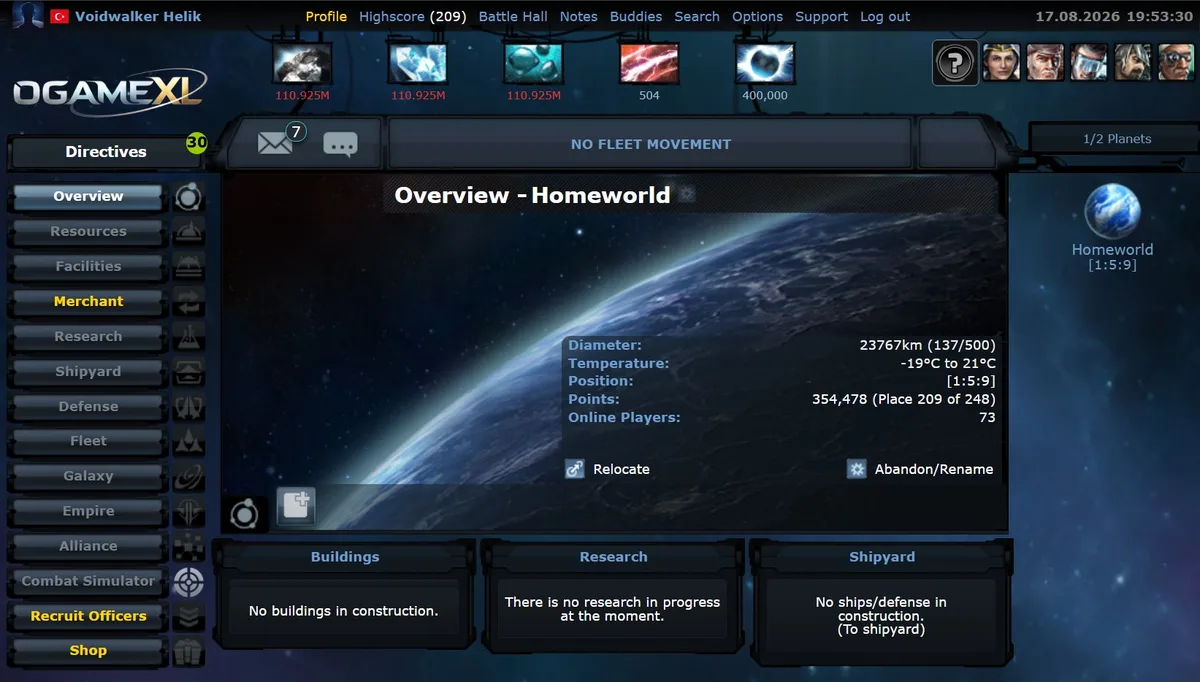
OGameXL runs the 2022 ruleset — the game as it was before lifeforms, with a faster economy and none of the systems stacked on top since. Same OGame, fewer menus.
Related Guides
Frequently Asked Questions
What's Your Reaction?
 Like
0
Like
0
 Dislike
0
Dislike
0
 Love
0
Love
0
 Funny
0
Funny
0
 Wow
0
Wow
0
 Sad
0
Sad
0
 Angry
0
Angry
0

Playing and helping run OGame.life since its early seasons. Every build order, fleet composition, and expedition setup covered in these guides has been tested first-hand on our own servers before being written up.








Comments (0)