



OGame Planet Sizes 2026: Fields, Slots & Best Positions
Last updated: June 2026 | Category: OGame Strategy & Mechanics

OGame Planet Sizes 2026: Complete Guide to Fields, Slots & Colonization Strategy
Last updated: June 2026 | Category: OGame Strategy & Mechanics
One of the most fundamental decisions in OGame is where to place your colonies. Every planet has a limited number of fields — the building slots that determine how far you can develop a world. Choose the wrong slot, and you'll hit a wall long before your rivals. Choose wisely, and you'll have room to grow for years.
This guide covers everything you need to know about OGame planet sizes in 2026: how fields work, which slots give the biggest planets, class bonuses, universe modifiers, and how to maximize your empire's potential.
In this guide
- What Are Planet Fields in OGame?
- OGame Planet Fields by Slot — Full Table (2026)
- Best Slots for Colonization: Slots 7, 8, and 9
- Home Planet: Always 163 Fields
- Class & Alliance Bonuses That Affect Planet Size
- Universe Settings: Field Bonuses
- How to Increase Fields on Existing Planets
- Slot Temperature & Production Tradeoffs
- Colonization Tips for Maximum Planet Size
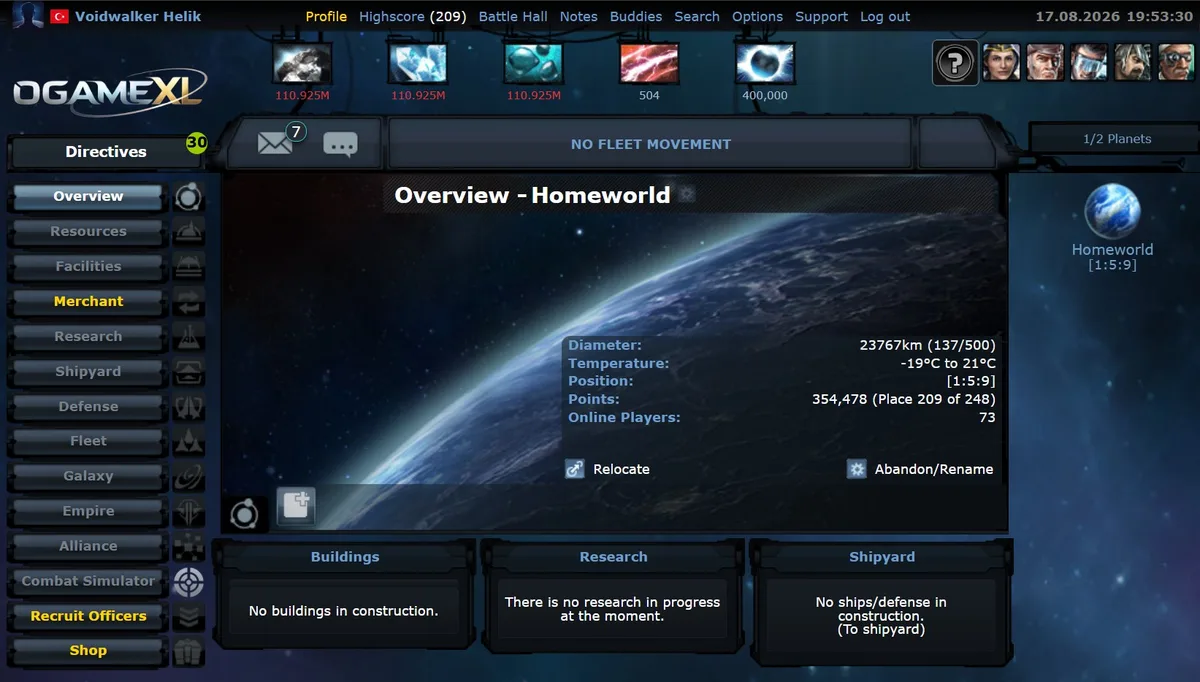
- How OGameXL Handles Planet Sizes
What Are Planet Fields in OGame?
In OGame, every planet has a finite number of fields. Each building upgrade — regardless of level — consumes exactly one field. When all fields are occupied, no new construction is possible unless you expand capacity through a Terraformer or planet field items.
This makes field count one of the single most important attributes of any colony. A planet with 240 fields can house a fully optimized end-game economy. A planet with 100 fields will leave you severely limited, especially in competitive universes.
Key rule: More fields = more buildings = stronger economy and fleet production. Always prioritize field count when colonizing.
OGame Planet Fields by Slot — Full Table (2026)
The number of fields a planet receives when colonized is randomly generated within a range determined by its slot position in the solar system. Below is the current distribution based on the redesigned universe format:
| Slot | Min Fields | Max Fields | Average | Notes |
|---|---|---|---|---|
| 1 | 96 | 172 | ~134 | Hottest, low deut |
| 2 | 104 | 184 | ~144 | |
| 3 | 112 | 196 | ~154 | |
| 4 | 118 | 208 | ~163 | Home planet slot |
| 5 | 126 | 220 | ~173 | |
| 6 | 134 | 232 | ~183 | |
| 7 | 142 | 244 | ~193 | ⭐ Prime colony zone |
| 8 | 148 | 256 | ~202 | ⭐⭐ Best balance |
| 9 | 150 | 258 | ~204 | ⭐⭐ Largest average |
| 10 | 142 | 250 | ~196 | |
| 11 | 130 | 232 | ~181 | |
| 12 | 114 | 208 | ~161 | |
| 13 | 98 | 182 | ~140 | |
| 14 | 82 | 156 | ~119 | |
| 15 | 66 | 140 | ~103 | Coldest, high deut |
Source: Official Gameforge / OGame Wiki (2026). Values reflect base fields before universe bonuses and class modifiers.
Best Slots for Colonization: Slots 7, 8, and 9
The sweet spot for colonization in the current redesigned universe is slots 7, 8, and 9. These positions offer the highest average field counts and the best chance of landing a 230+ field planet, which experienced players consider the minimum for a serious long-term colony.
- Slot 9 has the single highest potential field count (~258 max) and best average.
- Slot 8 is nearly identical and slightly warmer, useful if you want a balance of field count and solar satellite output.
- Slot 7 offers similar large-planet odds with a marginally higher temperature for players who care about energy production.
Slots 1–3 and 13–15 should generally be avoided for main colonies unless you have a very specific strategic reason (e.g., a slot 15 deuterium farm).
Home Planet: Always 163 Fields
Your starting home planet always has exactly 163 fields, regardless of which slot it spawns in. This is hardcoded in the game. While 163 is functional, experienced players often abandon the home planet later in the game once they've secured larger colonies via colonization.
Some universes include a homeplanet bonus (+20 fields), raising it to 183 fields.
Class & Alliance Bonuses That Affect Planet Size
Since the introduction of the class system, planet field counts are no longer purely determined by slot. Two modifiers can significantly increase the size of planets you receive:
Discoverer Class
The Discoverer class grants a +10% bonus to planet diameter, which translates to approximately +21% more fields on colonized planets. This makes Discoverer the go-to class for players focused on economy and expansion.
For example, a base slot-9 planet averaging ~204 fields becomes ~247 fields as a Discoverer — nearly 50 extra building slots.
Researcher Alliance Class
Members of a Researcher-class alliance receive an additional +5% bonus on planet size. Combined with the Discoverer player class, this stacks for significant field advantages.
Universe Settings: Field Bonuses
Every OGame universe has its own configuration, and many include a flat field bonus applied to all planets after class modifiers. Common values are +30, +40, or +50 bonus fields per planet. This bonus is added after percentage bonuses are calculated.
Always check your specific universe's settings in the game's universe overview page before planning your colonization strategy.
How to Increase Fields on Existing Planets
If you already have a colony and want to expand its field count, there are several options:
1. Terraformer
The Terraformer is the primary in-game building for expanding planet capacity. Each level of the Terraformer adds +5 fields (and consumes 1 field itself, so net gain is +4 per level at higher levels). With Terraformer level 15, you can add up to 60 extra fields on a planet.
2. Lifeform: High-Performance Terraformer (Humans)
The Human Lifeform research High-Performance Terraformer increases the field gain per Terraformer level, allowing you to squeeze even more space out of each level.
3. Planet Field Items (Shop)
Via the Dark Matter shop, players can purchase planet field expansion items that add a fixed number of fields permanently. These are particularly useful for players who've already maxed out their Terraformer.
4. Plasma Terraformer (Lifeform Research)
Another Humans Lifeform research that further boosts Terraformer efficiency.
Slot Temperature & Production Tradeoffs
Planet slot doesn't just affect field count — it also determines temperature, which directly impacts:
- Deuterium production: Colder planets (higher slot numbers) produce significantly more deuterium per Synthesizer level. Slot 15 is by far the best deuterium producer.
- Solar satellite energy: Hotter planets (lower slot numbers) generate more energy per satellite. Slot 1 is ideal for solar sat farms.
Most players balance this by placing main economy colonies on slots 7–9 and maintaining a dedicated deuterium farm on slot 13–15.
Colonization Tips for Maximum Planet Size
- Target slots 8 or 9 for your main colonies. These slots give the best average field count in the current game.
- Play as Discoverer class if field size is a priority. The ~21% bonus can mean 40–50 extra fields per planet.
- Be willing to abandon small colonies. If you get a slot-9 planet with only 170 fields, don't settle — delete and retry. With Astrophysics research, re-colonizing is inexpensive.
- Check universe bonuses. A +50 universe bonus combined with Discoverer class means even slot-6 planets can comfortably reach 250+ fields.
- Avoid slots 1, 14, and 15 for main colonies unless you specifically need temperature-dependent production (energy or deuterium).
- Plan your Terraformer early. Build it on every serious colony — each level is 4 net fields and essential for end-game development.
How OGameXL Handles Planet Sizes
If you're looking for a private OGame experience with full control over universe configuration, OGameXL is a custom private server running a modernized 2Moons-based engine with PHP 8.x and active development. On OGameXL, universe settings including field bonuses, colonization ranges, and Terraformer behavior can be configured independently, giving players and admins flexibility that the official servers don't offer.
The beta universe at beta.ogame.life is where new mechanics and balancing tweaks are tested before going live — including adjustments to planet size distributions and colonization formulas. If you want to experience a well-maintained private OGame server with active gameplay and regular updates, OGameXL is well worth checking out.
Related Guides
Frequently Asked Questions
What's Your Reaction?
 Like
0
 Dislike
0
 Love
0
 Funny
0
 Wow
0
 Sad
0
 Angry
0

Playing and helping run OGame.life since its early seasons. Every build order, fleet composition, and expedition setup covered in these guides has been tested first-hand on our own servers before being written up.













Comments (0)