



OGame x1000 Explained: Speed Settings, Real Math & Where to Play (2026)
x1000 in OGame means the economy runs 1000 times faster, while research and fleet speed are separate, much smaller multipliers. This guide breaks down the real math and shows a live x1000 universe you can join for free.

Short answer: "OGame x1000" refers to a universe whose economy speed is multiplied by 1000, so mines produce 1000 times more per hour and buildings and ships finish 1000 times faster. It does not mean everything is 1000x. Research and fleet speed are separate settings with their own, far smaller multipliers, and no official Gameforge universe has ever run at x1000. x1000 exists only on private servers.
If you have searched for "OGame x1000" you have probably seen a dozen private servers advertising the number, and almost none of them explaining what it actually changes. The multiplier is real and it transforms the game, but it applies to one specific part of it. Get that wrong and you will join a universe expecting instant interstellar warfare and find yourself watching a fleet crawl across the galaxy at almost normal speed.
This guide breaks down what each speed setting does, shows the actual formulas with worked numbers, and finishes with a live x1000 universe whose complete settings are published openly so you can check every figure yourself.
In this guide
- What does x1000 actually mean in OGame?
- The math: what x1000 does to your empire
- Why fleet speed is only x6 when the economy is x1000
- Official OGame speed universes vs private x1000 servers
- "x1000" is not a standard: the 8 numbers you should ask for
- Where to play OGame x1000 in 2026: OGameXL
- What an x1000 universe actually looks like
- How an x1000 universe stays fair
- How to start on OGameXL
- Is x1000 right for you?
What does x1000 actually mean in OGame?
Every OGame universe, official or private, is configured with a set of independent speed multipliers. The three that matter most are economy speed, research speed and fleet speed, and they are set separately. A server described as "x1000" is almost always quoting only the first one.
| Setting | What it multiplies | What it does not touch |
|---|---|---|
| Economy / development speed | Metal, Crystal and Deuterium mine output per hour; building upgrade times; shipyard and defence build times; resources and ships found on expeditions | Research, fleet travel, combat resolution |
| Research speed | How long each technology in the Research Lab takes | Everything else |
| Fleet speed | How long a fleet takes to fly from A to B. Usually split into three values: war missions (attack, destroy), holding missions, and peaceful missions (transport, deploy, expedition, colonise) | Deuterium cost of the flight, combat maths, cargo capacity |
So a "x1000 server" with a x6 fleet speed is a universe where you can build a thousand Battleships in the time it used to take to build one, and then wait a few minutes for them to arrive. That is not a flaw. As you will see below, it is the single design decision that keeps a high-speed universe playable.
The math: what x1000 does to your empire
OGame's core formulas are public and unchanged across versions, so the effect of a multiplier is easy to calculate exactly rather than guess at. Here is each one with a worked example.
Mine production
Hourly metal output is 30 × Level × 1.1^Level × economy speed. Crystal uses 20 instead of 30, Deuterium uses 10 and is additionally modified by planet temperature.
- A Metal Mine at level 25 produces 8,126 metal per hour on a standard x1 universe.
- The same mine on an x1000 universe produces 8,126,000 per hour, which is roughly 195 million metal per day from a single mine on a single planet.
Building times
Construction time in hours is (metal cost + crystal cost) / (2500 × (1 + Robotics Factory level) × 2^Nanite Factory level × economy speed).
- Upgrading a Metal Mine from 25 to 26 costs about 1,515,000 metal and 379,000 crystal. With a Robotics Factory at level 10 and no Nanite Factory, that is 68 hours 52 minutes on x1.
- On x1000 the same upgrade takes 4 minutes 8 seconds.
Ship production
Shipyard output uses the same formula with the Shipyard level in place of Robotics.
- A Battleship (45,000 metal + 15,000 crystal) with a level 10 Shipyard takes 2 hours 11 minutes on x1.
- On x1000 it takes about 8 seconds. A full fleet of a thousand Battleships completes in a little over two hours.
Research
Research time in hours is (metal cost + crystal cost) / (1000 × (1 + Research Lab level)), divided by the research speed multiplier. Note that this multiplier is set independently and is frequently lower than the economy multiplier, deliberately.
- Hyperspace Technology level 8 costs 512,000 crystal. With a level 12 Research Lab that is 39 hours 23 minutes on x1.
- At a research speed of x500 it takes 4 minutes 44 seconds.
Fleet travel
This is the one the economy multiplier never touches. Flight duration in seconds is (35000 / speed% × √(distance × 10 / ship speed) + 10) / fleet speed multiplier, where distance is 1,000 + 5 per planet slot within a system, 2,700 + 95 per system within a galaxy, and 20,000 per galaxy.
Here is a Battleship (base speed 10,000) flying at 100% on a x1 universe compared with a universe running x6 war fleet speed and x8 peaceful fleet speed:
| Route | Distance | x1 fleet | x6 (attack) | x8 (transport / expedition) |
|---|---|---|---|---|
| Planet to planet, same system | 1,040 | 6m 07s | 1m 01s | 46s |
| 20 systems away, same galaxy | 4,600 | 12m 41s | 2m 07s | 1m 35s |
| One galaxy away | 20,000 | 26m 15s | 4m 23s | 3m 17s |
| Four galaxies away (the maximum in a 9-galaxy universe) | 80,000 | 52m 20s | 8m 43s | 6m 33s |
One consequence worth knowing before you fleetsave: the fleet speed multiplier shortens the flight but does not reduce the deuterium bill for a 100% mission, because consumption is calculated from distance and ship count rather than from elapsed time. That is why well-configured high-speed universes add a separate fuel discount on top.
Why fleet speed is only x6 when the economy is x1000
This is the part most "what is x1000" articles skip, and it is the thing that actually determines how the universe plays.
When the economy runs at x1000, resources stop being a meaningful constraint within days. Mines reach the levels where further upgrades are pointless, defence can be rebuilt in seconds, and losing a fleet is no longer an economic catastrophe. If fleet speed were scaled to match, there would be nothing left to plan around: attacks would land before anyone could react, and the game would collapse into a reflex contest.
By keeping fleet speed in the x6 to x8 range, a x1000 universe converts the game's scarce resource from materials into time and position. What still matters:
- Fleetsaving still works. A four-to-nine minute window is short, but it is a window. Timing, deploy targets and moon positioning remain genuine skills.
- Where you colonise decides who you can farm. With flight time as the real cost, a well-placed colony in a busy system is worth more than a higher mine level. Our planet finder and coordinates guide matters more here, not less.
- Research becomes the real ladder. When research runs at half the economy rate, technology levels are what separate players, since everyone's buildings max out quickly. Combustion, Impulse and Hyperspace Drive levels directly cut those flight times further.
- Espionage is mandatory. Fleets are enormous and rebuilt instantly, so hitting the wrong target costs you the one thing you cannot manufacture: the flight.
Official OGame speed universes vs private x1000 servers
There has never been an official OGame x1000 universe, and there almost certainly never will be. Gameforge's own configuration ranges cap economy speed in the low single digits, typically x1 to x8, with research speed set as a multiple of the economy value and fleet speed required to be equal to or lower than the economy speed. Even the fastest official "speed universes" are x5 to x8 events that run for a season.
| Official OGame universe | Official speed universe | Private x1000 universe | |
|---|---|---|---|
| Economy speed | x1 to x4 | x5 to x8 | x1000 and above |
| Time to a serious fleet | Months | Weeks | Days |
| Time to max mines | A year or more | Months | Under a week |
| What limits you | Resources | Resources | Flight time and activity |
| Universe lifespan | Years | One season | Varies by operator |
That is the real trade-off. Official servers give you permanence and a huge population; a private x1000 server gives you the whole arc of an OGame universe, from first colony to Deathstar, inside a timeframe you can actually finish. Our full comparison of the best OGame private servers in 2026 and the OGame Classic servers guide cover the other end of that spectrum.
"x1000" is not a standard: the 8 numbers you should ask for
There is no specification behind the label. One server means economy x1000 and nothing else; another advertises "x1000" while running resources at x3000, buildings at x1000 and fleet at x10. Two universes with the same headline number can play completely differently.
Before you invest weeks in a universe, get these eight values in writing:
- Economy / development speed — the headline number.
- Research speed — if it matches the economy, technology stops differentiating players.
- Fleet speed, split by mission type — war, holding and peaceful are usually different.
- Deuterium consumption modifier — decides whether long-range raiding is viable at all.
- Number of galaxies — sets the maximum flight time and how spread out the population is.
- Debris field percentages — separately for destroyed ships and destroyed defence.
- Dark Matter policy — granted, earned, or sold. This is the single biggest fairness signal.
- Attack and pushing limits — whether a large account can simply sit on a small one.
A server that publishes all eight before you register is telling you something useful about how it is run. A server that will not is also telling you something.
Where to play OGame x1000 in 2026: OGameXL
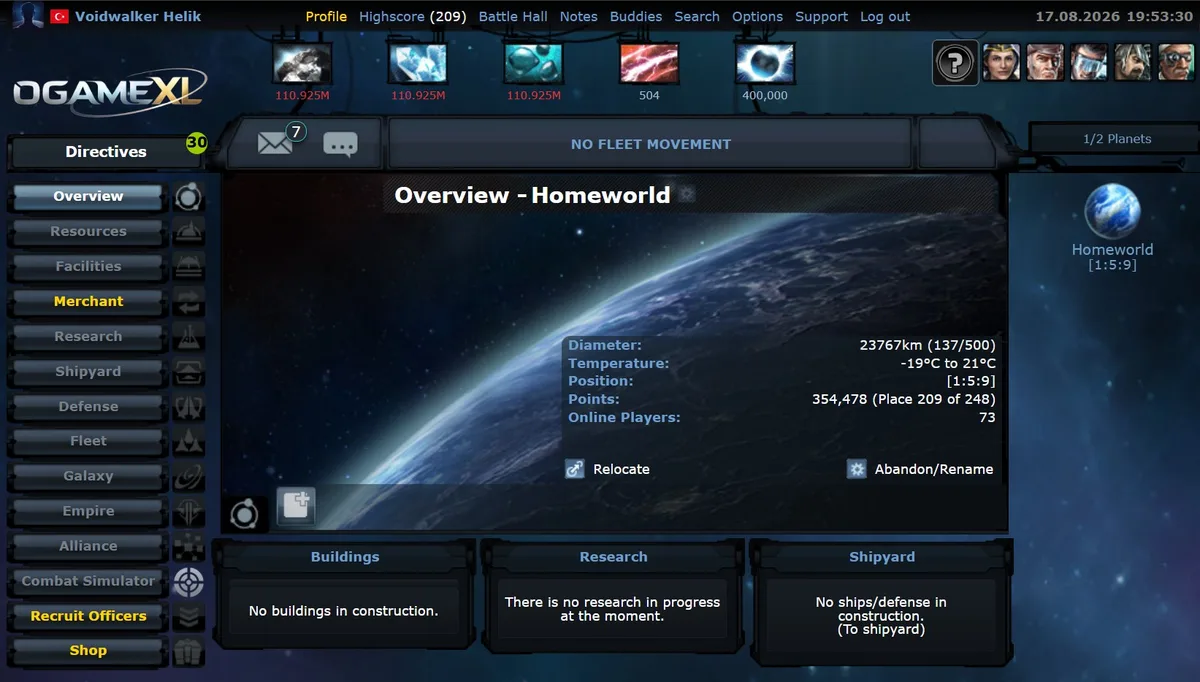
OGameXL is a free, browser-based OGame private server whose current universe runs at exactly the configuration this article has been describing: a x1000 economy with x500 research and x6 to x8 fleet speed. Every setting below is displayed in the client's universe selection screen before you commit to an account, and the server's community wiki documents the 1000x economy publicly as well.
Universe I "Centaurus": full settings
| OGameXL — Universe I, Centaurus (opened 11 August 2026) | |
|---|---|
| Development (economy) speed | x1000 |
| Research speed | x500 |
| War fleet speed | x6 |
| Holding fleet speed | x6 |
| Peaceful fleet speed | x8 |
| Fleet deuterium consumption | 30% discount |
| Galaxies | 9 |
| Planet field bonus | +0% (standard planet sizes) |
| Debris from destroyed ships | 80% |
| Debris from destroyed defence | 0% |
| Deuterium in debris fields | Off |
| Empty / inactive systems skipped | Off (galaxy view is unfiltered) |
| Alliance Combat System (ACS) | Enabled |
| Starting Dark Matter | 250,000 |
| Dark Matter renewal | 150,000 every 7 days, automatic |
What those numbers mean in practice
- Research at half the economy rate is the balancing lever. Buildings finish in minutes, so within a week everyone's infrastructure looks similar. Technology is what still takes real time, which means drive levels, weapons and shielding are where a serious player pulls ahead.
- 80% ship debris with 0% defence debris changes the entire target selection calculus. Crashing a fleet returns four fifths of its construction cost to the debris field, so fleet combat and recycling become the dominant economy, and moons appear quickly. Meanwhile turtling costs the attacker everything and gives them nothing back, so defence is a genuine deterrent rather than a debris farm.
- Nine galaxies with a x6 war fleet means the longest possible attack run is under nine minutes. The map is large enough to matter without any target being effectively unreachable.
- The 30% fuel discount is what makes cross-galaxy play affordable. As shown above, a faster universe does not reduce fuel cost by itself, so this is a separate, deliberate setting.
- Dark Matter is issued by the server, not sold to you. 250,000 on arrival and another 150,000 automatically every seven days means expedition boosts, build-queue instant-completes and merchant trades are available to everyone at the same rate, regardless of spending.
The game itself is classic, pre-Lifeforms OGame
OGameXL is not a reimagining, and it is not a modified copy of the official client either. It is an independently built game that deliberately reproduces the OGame formula as it was before Lifeforms: the same three resources, the same single research tree, the same ship roster from Light Fighter to Deathstar with the original rapidfire tables, moons and Sensor Phalanx, Jump Gates, the three player classes, officers and the Merchant, expeditions with their full range of outcomes, and the same seasonal in-game events players know from the official servers.
What is deliberately absent is the 2023-onwards layer: no Lifeforms buildings, no second technology tree competing for your research queue, no artefacts, and no per-colony racial bonuses to plan around. For a large part of the OGame playerbase that is the entire appeal, and it is the reason a x1000 economy works here at all. Lifeforms adds a parallel progression track that a 1000x multiplier would flatten into meaninglessness; without it, the classic build/research/fleet loop stays intact and the speed setting only changes the tempo. If you have played OGame at any point in the last fifteen years, there is nothing to relearn beyond the pace. The community wiki documents each part of it in detail: buildings and facilities, the research tree and its prerequisites, ship stats, combat mechanics and the simulator, and alliances and their three classes — Warriors gain fleet speed and espionage scanning, Traders gain production and storage, and Researchers gain colony size and expedition speed.
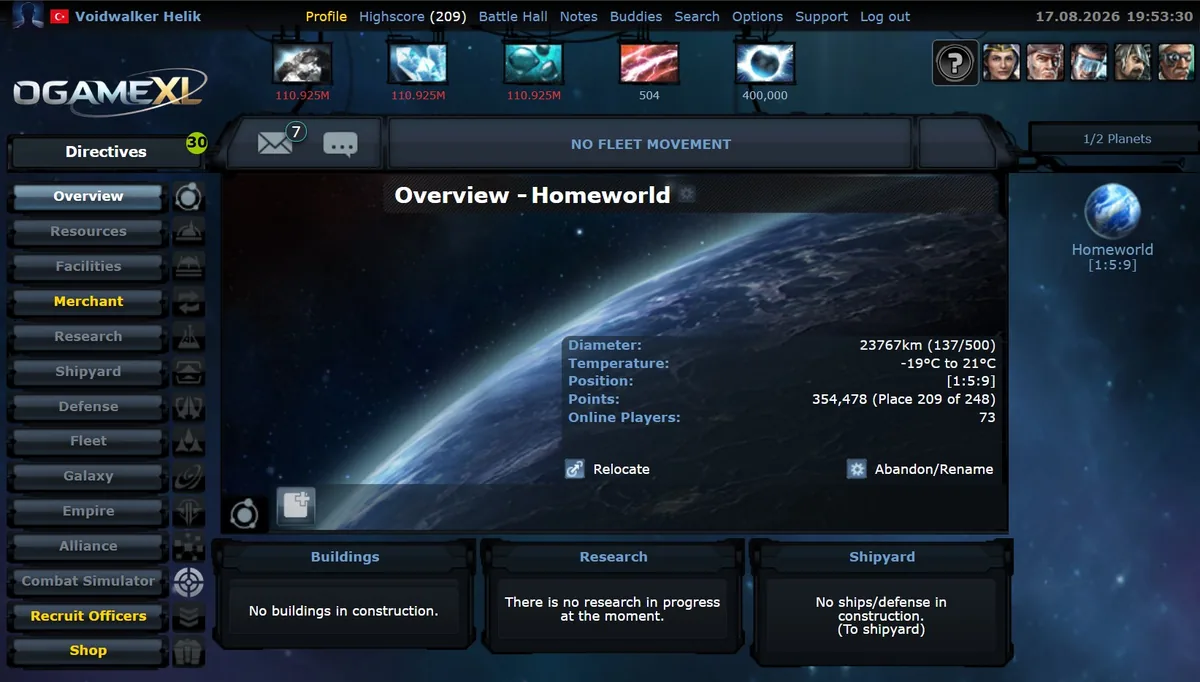
The client is browser-based with no download, works properly on mobile, and the interface is available in 13 languages including English, German, French, Italian, Spanish, Portuguese, Polish, Dutch, Russian, Czech, Greek, Turkish and Traditional Chinese. Registration is free, with email or Google sign-in.
What an x1000 universe actually looks like
Numbers on a settings page are abstract. Here is what they produce in a live universe, taken from Centaurus itself.
Scores run into the hundreds of millions
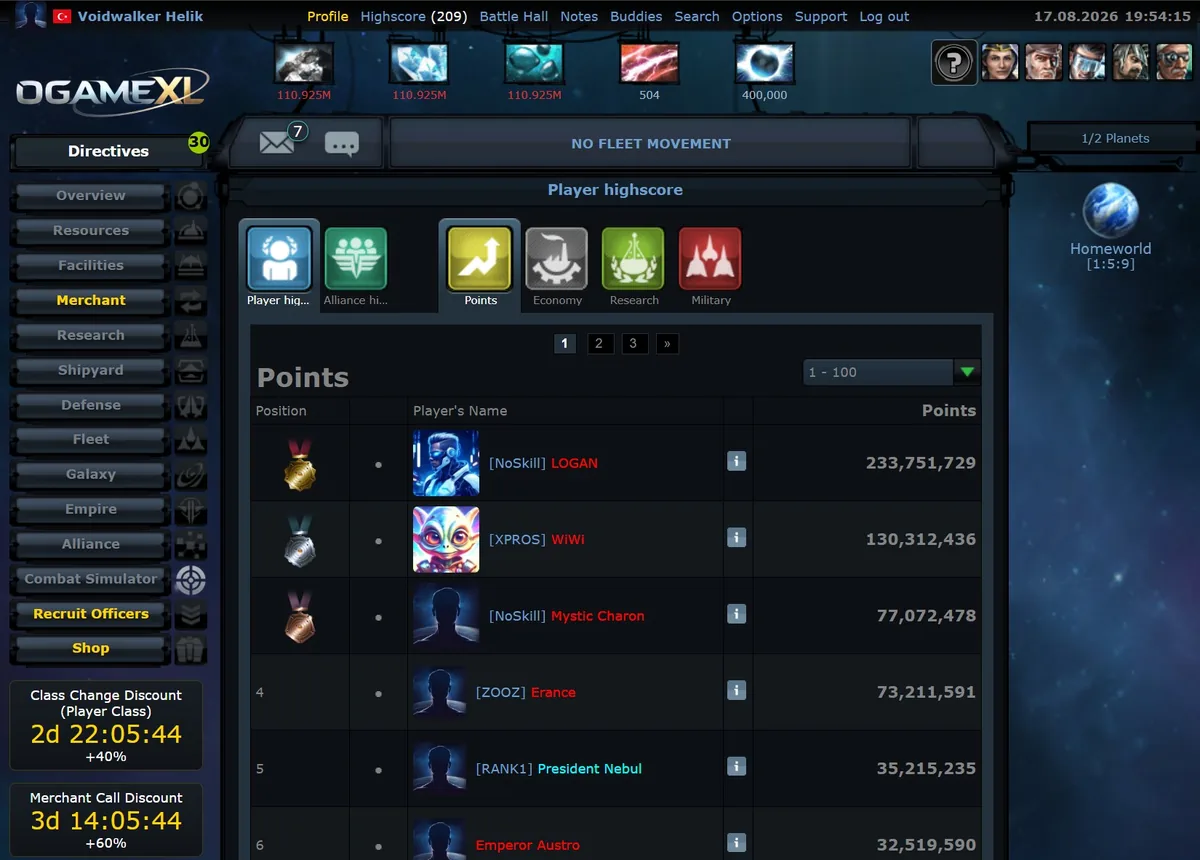
On the official servers, a top-ten account in an established universe typically sits somewhere in the millions of points after years of continuous play. In this x1000 universe the leading account is on 233,751,729 points, with second place at 130 million and sixth still above 32 million. That is the economy multiplier expressed as a scoreboard, and it is also why the strength rule has to be weighted rather than based on raw score: at these magnitudes a building-heavy account and a fleet-heavy account with identical totals are nowhere near the same threat.
Fleets are counted in hundreds of thousands
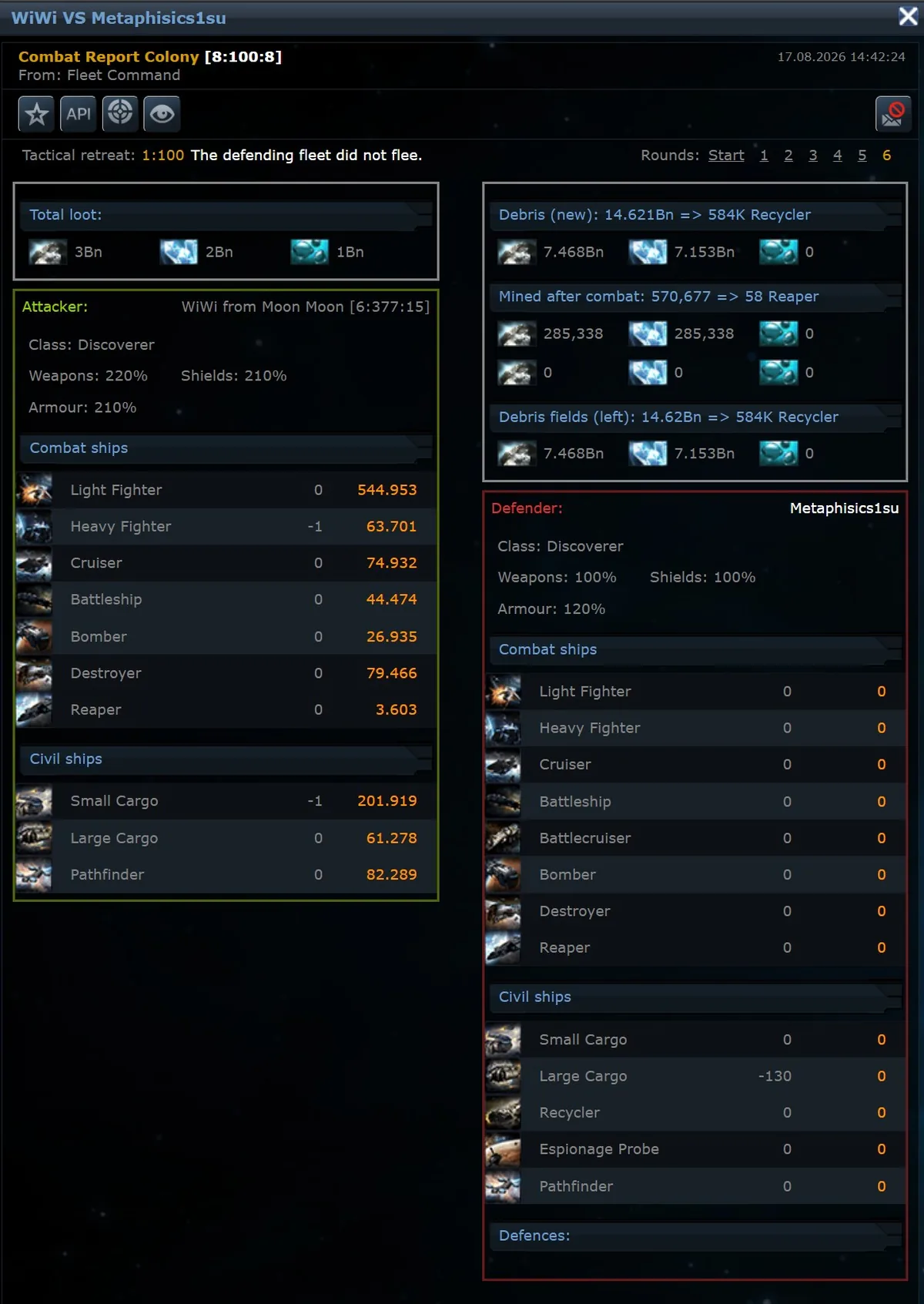
This single report tells you more about x1000 than any description can:
- The attacking fleet is 544,953 Light Fighters, 201,919 Small Cargo, 82,289 Pathfinders, 79,466 Destroyers, 74,932 Cruisers, 63,701 Heavy Fighters, 44,474 Battleships, 26,935 Bombers and 3,603 Reapers. At x1000, ship counts that would be a universe-defining armada on an official server are ordinary.
- The loot is 3 billion metal, 2 billion crystal and 1 billion deuterium in one raid.
- The debris field comes to 14.62 billion units of metal and crystal, which the report calculates would need 584,000 Recyclers to clear. Recycling is not a side activity in this universe, it is a logistics operation in its own right.
- The debris contains zero deuterium, which is the "Deuterium in debris fields: Off" setting from the table above showing up in practice.
- The technology gap decides the fight. The attacker is running Weapons 220%, Shields 210% and Armour 210% against a defender on 100% / 100% / 120%. Both sides can build ships in seconds; only one of them spent the research time. This is the x500 research track doing exactly the job it was set for.
- Player classes are live. Both accounts are flying the Discoverer class, one of the three player classes from the modern OGame build, alongside the full post-2016 ship roster including Reapers, Pathfinders and Battlecruisers.
- The attack crossed galaxies, launched from a moon at [6:377:15] against a colony at [8:100:8]. In a nine-galaxy universe at x6 war fleet speed, that flight is a matter of minutes, which is what makes an aggressive, galaxy-spanning play style viable here.
How an x1000 universe stays fair
Speed amplifies abuse. When a fleet rebuilds in minutes, a bot or a farm account does far more damage than it would on a x1 server, which is why the rule set matters more on a high-speed universe than anywhere else. OGameXL publishes its limits with actual numbers rather than vague promises, and enforces most of them in code rather than by report:
- Attack limits. A maximum of 21 attacks on one account per 24 hours, and 6 per individual planet or moon per day. The system blocks the attack outright once the limit is reached. Combat reports generated by probes being caught do not count towards it.
- The 7x strength rule, calculated properly. You may only attack players within seven times your strength, and strength is not raw total score. It is a weighted figure: building score × 0.15, research score × 0.20, fleet score × 0.50, defence score × 0.50, recalculated at the moment each fleet action is launched. That stops a fleet-heavy account from hiding behind a building-heavy score. Espionage is exempt, so anyone can scout anyone.
- Pushing is blocked at the engine level. Transports from an account seven times stronger are refused automatically, as are transfers to inactive accounts. Deliberately crashing fleets to move value between accounts is treated as fleet bashing and closes every account involved.
- Bots and automation are banned outright. Auto-attack, auto-fleet, auto-gather, mission scripts and CAPTCHA solvers are all account-closure offences. Screen recording and manual refreshing are explicitly allowed, so the line is drawn at software acting on your behalf, not at playing attentively.
- Anti-harassment flight rules. No fleet movement longer than 3 hours to another player's coordinates, at least 1 hour between long flights, and no more than two of a player's planets under a long flight at once. Given that the longest legitimate cross-galaxy run here is under nine minutes, that rule exists purely to stop deliberate slow-flight griefing.
- Probe spam limits. Starting a combat with more than 100 espionage probes alone is blocked, and adding probes to an ACS purely to slow the fleet down is prohibited.
- One account per universe, with shared-IP situations requiring operator approval in advance and no fleet movement between accounts on the same connection.
- Inactivity handling. Vacation mode caps at 30 days. A universe account untouched for 75 days may be removed and is deleted automatically at 120, which keeps the galaxy map free of permanent dead weight.
You can read the full rule set on the OGameXL rules page before registering.
How to start on OGameXL
- Go to ogamexl.com/register and create a free account with an email address or Google sign-in. One portal account covers every universe.
- Verify your email, then pick Universe I — Centaurus from the universe selection screen, where all the settings above are listed.
- Spend the first session on mines and Robotics Factory. At x1000 you will clear the early building tree in minutes, so do not stop to optimise it.
- Push Energy Technology and the drive technologies early. Research is the x500 track and therefore the genuine bottleneck.
- Colonise for position, not for fields. Flight time is the scarce resource here, so a system with active neighbours beats a large empty planet.
- Start fleetsaving as soon as you own anything worth taking. Your fleetsave window is measured in minutes, not hours.
- Keep the wiki's OGameXL beginner's guide open alongside you for the build order, the early research priorities and the common opening mistakes.
New to the game entirely? Start with our complete OGame beginner's guide, then come back for the speed-specific parts. If you also play on OGame.life, the OGame login guide covers account access there.
Is x1000 right for you?
| x1000 suits you if… | Stick to a slower universe if… |
|---|---|
| You want to reach Deathstars, moons and alliance wars within weeks rather than years | You enjoy the long grind and the weight of a single expensive decision |
| You are returning to OGame after a break and do not want to start years behind an established universe | You can only log in once every few days and want your fleet safe in between |
| You prefer fleet combat and timing over mine optimisation spreadsheets | Economy optimisation is the part you actually enjoy |
| You can check in several times a day during active periods | You want a universe that will still be running in five years |
| You want classic OGame without the Lifeforms layer, artefacts or a second tech tree | Lifeforms and its racial bonuses are a big part of why you play |
The honest summary: x1000 is not a shortcut version of OGame, it is a different game built from the same parts. Everything you learned about mine ratios matters less; everything you learned about fleetsaving, phalanx coverage and target selection matters far more.
Sources and further reading
- OGame Wiki: Universe and Server Settings — the official settings ranges and their definitions.
- OGameXL rules — the published limits quoted in this article.
- OGameXL Wiki — the server's own reference for buildings, research, ships, combat and alliances, and a public statement of its 1000x economy speed.
Related Guides
Frequently Asked Questions
What's Your Reaction?
 Like
0
 Dislike
0
 Love
1
 Funny
0
 Wow
0
 Sad
0
 Angry
0

Playing and helping run OGame.life since its early seasons. Every build order, fleet composition, and expedition setup covered in these guides has been tested first-hand on our own servers before being written up.













Comments (0)